Circus Elements 3D SVG: A Practical Guide for Creators and Makers
In the landscape of digital crafting, the quality of your source files dictates the ceiling of your final product. For professionals and hobbyists alike, finding assets that balance aesthetic appeal with technical reliability is a critical part of the workflow. The Circus Elements 3D SVG collection addresses this need by providing high-resolution vector graphics designed to look three-dimensional while maintaining the clean lines necessary for precision cutting. This resource is not merely a set of images; it is a functional component in the production pipeline for everything from custom apparel to edible cake decorations.
Understanding how these files integrate into your existing software environment is the first step toward efficient execution. Whether you are managing a small business or fulfilling personal creative goals, the ability to manipulate these assets without compromising their integrity is essential. This guide explores the practical application of Circus Elements 3D SVG within popular design ecosystems, focusing on preparation, compatibility, and the seamless transition from digital file to physical product.
Integrating Digital Assets into Your Workflow
The process of incorporating new digital assets begins long before the actual creation phase. It starts with acquisition and organization. When you download the Circus Elements 3D SVG collection, you receive a zipped folder containing all necessary files. This format is standard for protecting file integrity during transfer and ensuring that no metadata or layer information is lost. Before attempting to use these files, it is vital to extract the contents to a dedicated project directory. This simple organizational step prevents version confusion and ensures that your workspace remains clutter-free.
Once extracted, the next phase involves verification. While the collection is optimized for specific platforms, verifying file compatibility with your specific machine model is a crucial quality control measure. Most modern cutting machines rely on vector data to determine cut paths. The 3D effect in these SVGs is achieved through layered shading and distinct line weights rather than raster pixelation. This distinction allows the files to scale infinitely without losing resolution, a feature that is indispensable when moving between small stickers and large banner prints.
For users operating within a team or a structured business environment, establishing a consistent naming convention for these downloaded assets can streamline future projects. By categorizing the Circus Elements 3D SVG files alongside other thematic resources, you reduce the time spent searching for assets during the design phase. This level of preparation transforms a simple download into a strategic inventory item ready for immediate deployment.
Optimizing for Silhouette Studio and Cricut Design Space
The primary value proposition of the Circus Elements 3D SVG collection lies in its native compatibility with industry-standard software like Silhouette Studio and Cricut Design Space. These platforms are the engines behind most professional and semi-professional cutting operations. The files are engineered to import cleanly, meaning that layers remain editable, and colors are preserved as intended.
When working within Silhouette Studio, users will find that the 3D elements often come pre-separated into distinct layers. This structure allows for multi-color cuts without the need for manual tracing or complex ungrouping processes. You can easily assign different materials to each layer, enabling the creation of intricate designs where shadows and highlights are cut from contrasting vinyl or cardstock. This capability significantly reduces the time spent on post-import editing, allowing you to focus on layout and composition.
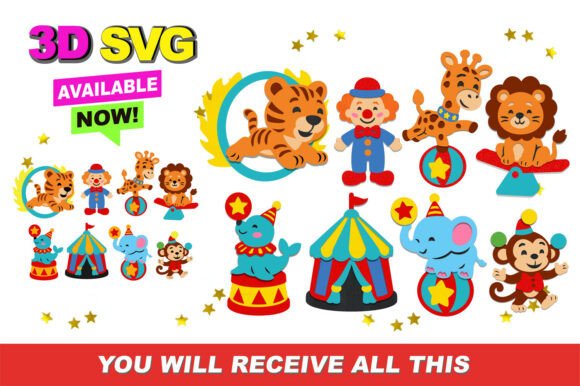
Similarly, Cricut Design Space handles these SVG files with high fidelity. Upon uploading, the software recognizes the vector paths immediately. The "Weld" and "Attach" functions in Design Space work seamlessly with the Circus Elements 3D SVG files, ensuring that the 3D illusion is maintained even after the design is flattened for cutting. This is particularly important for complex circus motifs, such as tents, balloons, and performers, where overlapping elements must align perfectly to create depth.
It is important to note that if you are using a different type of cutting machine, such as those from Brother, ScanNCut, or Graphtec, you must ensure your specific software can interpret SVG files correctly. While SVG is an open standard, some proprietary machines require conversion to DXF or other formats. In such cases, the vector nature of the Circus Elements 3D SVG files ensures they can be converted without significant loss of detail, provided the conversion tool maintains path accuracy.
Practical Applications Across Industries
The versatility of the Circus Elements 3D SVG collection extends far beyond a single craft category. Its utility spans multiple industries, offering solutions for entrepreneurs, educators, and event planners. Understanding the breadth of these applications helps in maximizing the return on investment for the asset pack.
Custom Apparel and Merchandise
For small business owners creating custom t-shirts, hats, or tote bags, the durability and clarity of these vectors are paramount. The 3D effect adds a premium touch that flat designs often lack. When applied to heat transfer vinyl (HTV), the layered nature of the design creates a textured look that stands out on fabric. Because the files are scalable, you can produce a logo for a small patch or a full-back print on a hoodie without any degradation in quality. This consistency is key for branding, ensuring that every piece of merchandise looks professional.
Event Decorations and Cake Toppers
In the realm of event planning, specifically for birthday celebrations and themed parties, these files offer rapid prototyping capabilities. Educators and party planners can use the Circus Elements 3D SVG files to create personalized invitations, banners, and table settings. A particularly effective use case is the production of cake toppers. By printing the SVGs on edible paper or cutting them from food-safe acetate, creators can add a dimensional element to desserts that elevates the overall presentation. The precision of the cut lines ensures that delicate details, such as the stripes on a circus tent or the fringe on a balloon, remain intact.
Stickers and Stationery
Freelancers and bloggers often rely on branded swag to build community engagement. Stickers are a cost-effective way to achieve this. The Circus Elements 3D SVG files are ideal for die-cut sticker production. The clear definition of the outer paths makes weeding—the removal of excess vinyl—quick and easy. This efficiency is critical when producing batches of stickers for trade shows, online store promotions, or subscriber gifts. The 3D aesthetic also gives the stickers a more tactile feel, increasing their perceived value among recipients.
Ensuring Quality and Consistency
While the files are designed for ease of use, achieving professional results requires attention to material selection and machine calibration. The 3D effect relies heavily on the contrast between layers. Therefore, choosing materials with appropriate opacity and color saturation is essential. For example, using translucent vinyl for shadow layers over opaque base layers can enhance the depth perception of the design.
Before committing to a full production run, always perform a test cut on scrap material. This step verifies that the blade depth and pressure settings are correct for the specific thickness of your chosen medium. Since the Circus Elements 3D SVG files contain fine details, a blade that is too dull or a pressure setting that is too low may result in incomplete cuts, ruining the visual integrity of the 3D effect. Conversely, excessive pressure can cause dragging or unwanted tears in delicate areas.
Organization also plays a role in long-term quality. Keep a record of which material types worked best with specific designs from the collection. Over time, this knowledge base becomes a valuable resource, reducing trial and error in future projects. By documenting successful combinations of file, material, and machine settings, you create a repeatable process that ensures consistency across all your outputs.
Strategic Implementation for Long-Term Success
Integrating the Circus Elements 3D SVG collection into your workflow is about more than just downloading and cutting. It is about recognizing how high-quality assets can streamline your creative process and elevate your brand. By prioritizing compatibility, organizing your digital library, and adhering to strict quality control measures, you transform these files into powerful tools for production.
Whether you are launching a new product line, preparing for a seasonal event, or simply exploring a new hobby, the flexibility of these vector files supports your goals. They bridge the gap between digital design and physical reality, offering a reliable foundation upon which creativity can flourish. As you continue to refine your techniques, remember that the most efficient workflows are built on the combination of superior resources and disciplined execution. The Circus Elements 3D SVG collection provides the former, while your expertise delivers the latter.