Dragon Head Cave 3D Model for 3D Printing: Creating Epic Fantasy Landscapes
For hobbyists, game masters, and creative designers, the quest to build immersive environments often hits a wall when it comes to finding high-quality terrain pieces that balance detail with printability. This is where the Dragon Head Cave 3D Model for 3D Printing emerges as a transformative solution. Designed to serve as an epic entrance sculpted by fantasy, this model creates the feeling of an ancient refuge, evoking the sensation that a massive creature itself guards the interior of the mountain. Unlike many intricate digital assets that fail during the physical manufacturing process, this specific design prioritizes solid volumes and well-defined details without fragile excesses, making it a reliable choice for creators at various skill levels.
The Challenge of Complex Terrain in 3D Printing
One of the most common hurdles for adults entering the world of 3D printing for hobbies or professional use is the "fragility factor." Many fantasy-themed models feature thin horns, delicate scales, or overhanging structures that require extensive support material. This not only increases the cost of filament but also leads to post-processing nightmares where removing supports can damage the very details you wanted to preserve. Furthermore, large-scale prints often suffer from warping or layer adhesion issues if the geometry is not balanced correctly.
When searching for a centerpiece for a tabletop role-playing game (RPG) table or a decorative diorama, users often struggle to find pieces that are both visually striking and structurally sound. The goal is usually to achieve a cinematic look—something that feels like a scene from a high-fantasy novel—without spending days troubleshooting failed prints. The Dragon Head Cave 3D Model for 3D Printing addresses these pain points directly by offering a design philosophy centered on accessibility and durability.
Design Philosophy: Balancing Aesthetics and Function
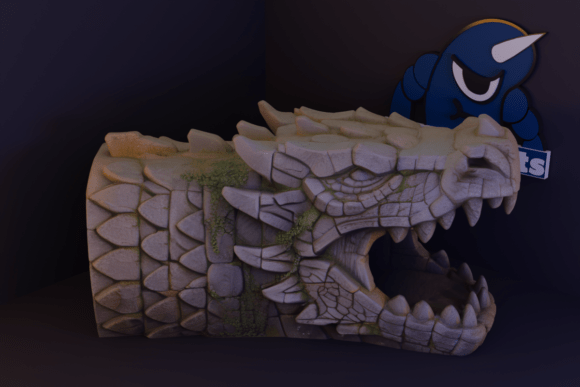
The core strength of the Dragon Head Cave lies in its thoughtful engineering. The design highlights the striking silhouette of the dragon's head integrated seamlessly into the cave structure. By utilizing continuous surfaces and balanced geometry, the model ensures that the 3D printing process remains smooth, even for beginners. The absence of fragile protrusions means that the piece can be printed with minimal support requirements, significantly reducing waste and post-print cleanup time.
This approach allows the user to focus on the outcome rather than the technical difficulties of the process. The model is constructed with solid volumes that provide weight and presence, ensuring that the final product feels substantial on a tabletop or shelf. Whether you are using PLA, PETG, or resin, the continuous nature of the surfaces helps maintain layer adhesion, resulting in a robust final piece that can withstand the rigors of handling during gameplay or display.
Practical Applications Across Different Scenarios
The versatility of the Dragon Head Cave 3D Model for 3D Printing makes it suitable for a wide array of applications beyond simple decoration. Its primary utility is found in RPG scenarios, where Dungeon Masters need dynamic props to enhance storytelling. Imagine describing a party entering a lair; having a physical representation of a dragon-headed cavern entrance adds a tangible layer of immersion that flat maps cannot provide. It serves as a natural focal point for encounters, hiding spots for treasure, or the mouth of a beast that players must navigate.
Beyond gaming, this model excels in themed decoration and dioramas. For enthusiasts building miniature landscapes, the cave acts as a perfect backdrop or foreground element, providing depth and narrative context. The open cavity allows for internal lighting setups, creating dramatic shadows and highlighting the texture of the dragon's features. Additionally, the model is ideal for dry aquariums, terrariums, and vivariums. In these biological settings, the cave offers a realistic shelter for reptiles or insects, blending functional habitat needs with aesthetic appeal. The smooth, non-porous finish achievable through proper printing and curing ensures the environment remains safe for live animals.
Tailoring the Print to Your Skill Level
While the model is designed to be beginner-friendly, different users may approach the printing process based on their specific goals and equipment. For those new to 3D printing, the balanced geometry of the Dragon Head Cave 3D Model for 3D Printing offers a forgiving learning curve. Beginners can focus on mastering basic slicing settings, such as infill density and wall thickness, without worrying about complex support removal. The recommendation here is to prioritize structural integrity, perhaps opting for a slightly higher infill percentage to ensure the cave walls feel heavy and durable.
Advanced users, on the other hand, might leverage the model's clean topology to experiment with multi-material printing or color changes. Since the design avoids fragile excesses, experienced printers can push the resolution limits to capture fine scale textures on the dragon's snout. They might also explore orienting the model differently to optimize print time or surface quality on the visible front face. Regardless of the approach, the underlying STL file provides a stable foundation that adapts to various printer capabilities, from entry-level FDM machines to high-end SLA resin printers.
Implementation Tips for Best Results
To get the most out of this project, consider the following practical recommendations. First, always inspect the STL file before slicing to ensure no scaling errors have occurred. While the model is designed for ease of printing, verifying dimensions against your intended space is crucial, especially if you plan to integrate it into a larger modular set. Second, while the design minimizes support needs, some minor supports may still be required depending on your printer's technology and the chosen orientation. Use your slicer software to generate tree supports where possible, as they are easier to remove and leave less scarring on the surface.
Post-processing is another area where attention yields significant rewards. Sanding the edges of the cave opening can soften the transition between layers, enhancing the organic feel of the stone and scales. If painting the model, a base coat of grey or earth tones will help unify the surface before adding weathering effects like moss, soot, or glowing runes inside the cave mouth. These finishing touches transform a raw 3D print into a convincing piece of fantasy art.
Bringing Fantasy to Life
The Dragon Head Cave 3D Model for 3D Printing represents more than just a digital file; it is a gateway to bringing epic atmospheres into the real world. By solving the common challenges of fragility and complexity, it empowers creators to focus on imagination and implementation. Whether you are setting the stage for a heroic adventure, designing a unique home decor piece, or crafting a habitat for a pet, this model delivers impact and presence. It stands as a testament to how thoughtful design can bridge the gap between digital creativity and physical reality, inviting everyone to explore the depths of their own fantasy universe.