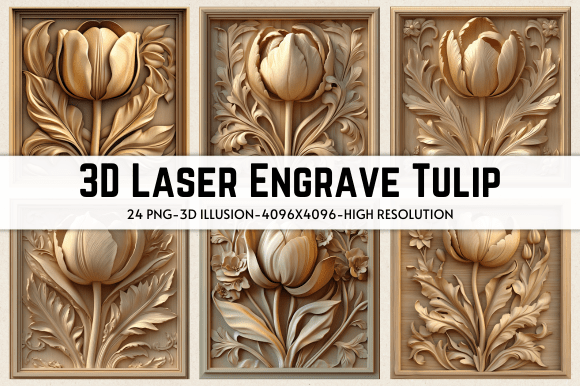
3D Laser Engrave Tulip: Bringing Depth and Detail to Your Woodworking Projects
There is a distinct satisfaction in transforming a flat sheet of wood into a piece of art that seems to have depth, shadow, and life. This transformation is often the goal when crafters and makers search for a 3D Laser Engrave Tulip design. Unlike standard vector cuts that define edges, or simple line art that outlines shapes, a 3D laser engraving file relies on grayscale values to dictate how much energy the laser applies at any given point. The result is an image where the petals of a tulip appear to curl away from the viewer, catching light in a way that mimics a real flower rather than a printed sticker.
The specific resource known as the 3D Laser Engrave Tulip PNG collection is designed to bridge the gap between digital artistry and physical manufacturing. It provides high-resolution grayscale images optimized specifically for the way modern laser machines interpret data. Whether you are running a Glowforge, an xTool, or using LightBurn software, these files are engineered to handle the nuances of shading without requiring complex manual adjustments from the user. The core value lies in the preparation; the files are already converted into the correct format, ensuring that the transition from your computer screen to your workbench is seamless.
Understanding the Grayscale Advantage in Laser Art
When working with laser engravers, the medium of the machine dictates the quality of the output. A 3D Laser Engrave Tulip file utilizes a technique where the darkness of a pixel corresponds directly to the power of the laser beam. Darker areas burn deeper or longer, creating shadows, while lighter areas receive less energy, simulating highlights. This is why the inclusion of both coloring and grayscale PNGs in this package is so vital. The grayscale version is the engine that drives the engraving process, allowing the machine to "paint" with fire.
For those new to the concept, it might seem counterintuitive that a black-and-white file creates such vibrant results. However, the beauty of the tulip design comes from the texture of the material itself. On lighter woods like birch plywood or maple, the contrast between the natural grain and the charred lines creates a warm, organic aesthetic. The high resolution of these files—specifically the 4096 x 4096 pixel dimensions—ensures that even the delicate veins of the tulip petals remain crisp. There is no pixelation or blurring, which is a common issue when lower-quality images are scaled up for large projects.
Real-World Applications for Home Decor and Gifting
The versatility of the 3D Laser Engrave Tulip design extends far beyond a single use case. In the realm of home decor, these images are perfect for creating wall art that feels bespoke. Imagine a series of three wooden panels, each featuring a different stage of the tulip bloom, mounted above a sofa. The depth created by the engraving catches the ambient light of a room differently throughout the day, making the artwork feel dynamic rather than static. Because the files come with transparent backgrounds, they can be easily resized or combined with other elements in design software before being sent to the laser cutter.
Gift-giving is another massive sector where this design shines. Personalized coasters, cutting boards, and jewelry boxes are highly sought-after items, especially during spring seasons or for Mother's Day. The tulip, a symbol of perfect love and rebirth, resonates deeply with recipients. Using the 3D Laser Engrave Tulip file allows creators to produce gifts that look professionally manufactured but carry the heart of a handmade item. The ability to engrave on various materials means you aren't limited to wood; leather wallets, slate tiles, and even certain textiles can accept this type of dithered engraving, expanding the range of potential products.
Optimizing Your Workflow with Specific Machine Settings
While the files are prepared for compatibility, understanding how to leverage them on specific hardware ensures the best possible outcome. For users of the Glowforge ecosystem, the settings provided with the 3D Laser Engrave Tulip package serve as a reliable starting point. Setting the speed to 1000 mm/min and the power to 90% strikes a balance between detail and speed. Crucially, selecting the "Vary Power" option for grayscale processing allows the machine to modulate its intensity based on the image data. Increasing the Lines Per Inch (LPI) to 270 enhances the smoothness of the gradients, preventing the "banding" effect that can sometimes ruin subtle shading.
For those utilizing LightBurn, the approach shifts slightly toward dithering algorithms. The Jarvis dither filter mentioned in the instructions is particularly effective for floral designs. It spreads the dots in a way that the human eye perceives as continuous tone, which is essential for the soft curves of a tulip petal. The fact that the 3D Laser Engrave Tulip file is pre-optimized for this means users can skip hours of trial and error. You simply load the image, apply the filter, and let the machine do the work. This efficiency is a game-changer for small business owners who need to maintain consistent quality across multiple orders.
Material Considerations and Design Flexibility
Not all surfaces react to laser engraving in the same way, and choosing the right substrate is just as important as the design file itself. Lighter woods are generally the ideal canvas for the 3D Laser Engrave Tulip because they offer the highest contrast against the darkened engraving. Birch, basswood, and poplar are excellent choices that highlight the intricate details of the grayscale image. However, if you are working with darker woods like walnut, you may need to adjust the power settings or consider a white chalk spray to make the engraved lines pop.
Beyond wood, the applications open up significantly. Textile enthusiasts can use these files to create unique patterns on cotton or linen, though the depth will differ from wood. Stationery designers might use the design for embossed-style effects on thick cardstock or paper goods. The 13 x 13-inch size of the source files provides ample room to crop or zoom, allowing you to fit the tulip into a small keychain or scale it up for a large feature wall. The transparency of the background ensures that there are no unwanted white borders interfering with your layout, giving you total creative control over the final composition.
Maximizing Value with Instant Digital Downloads
In today's fast-paced creative economy, time is a valuable resource. The instant download nature of the 3D Laser Engrave Tulip package eliminates shipping delays and allows you to start creating immediately after purchase. The compressed folder containing 24 coloring and 24 grayscale PNG files offers a library of variations to explore. This variety is crucial for testing different looks or offering customers a choice of styles. Whether you prefer a monochromatic look or want to experiment with colored overlays before engraving, having multiple versions at your disposal streamlines your workflow.
It is also worth noting the importance of compatibility checks before diving into a project. While the files are optimized for major brands like Glowforge, xTool, and LightBurn, every machine has its own personality. Running a test square on scrap material is always recommended to fine-tune the power and speed settings for your specific environment. This small step ensures that the final product meets your high standards and that the investment in the design files yields professional results every time. By combining high-quality digital assets with careful machine calibration, the 3D Laser Engrave Tulip becomes more than just an image; it becomes a tool for crafting memorable, tangible art.